
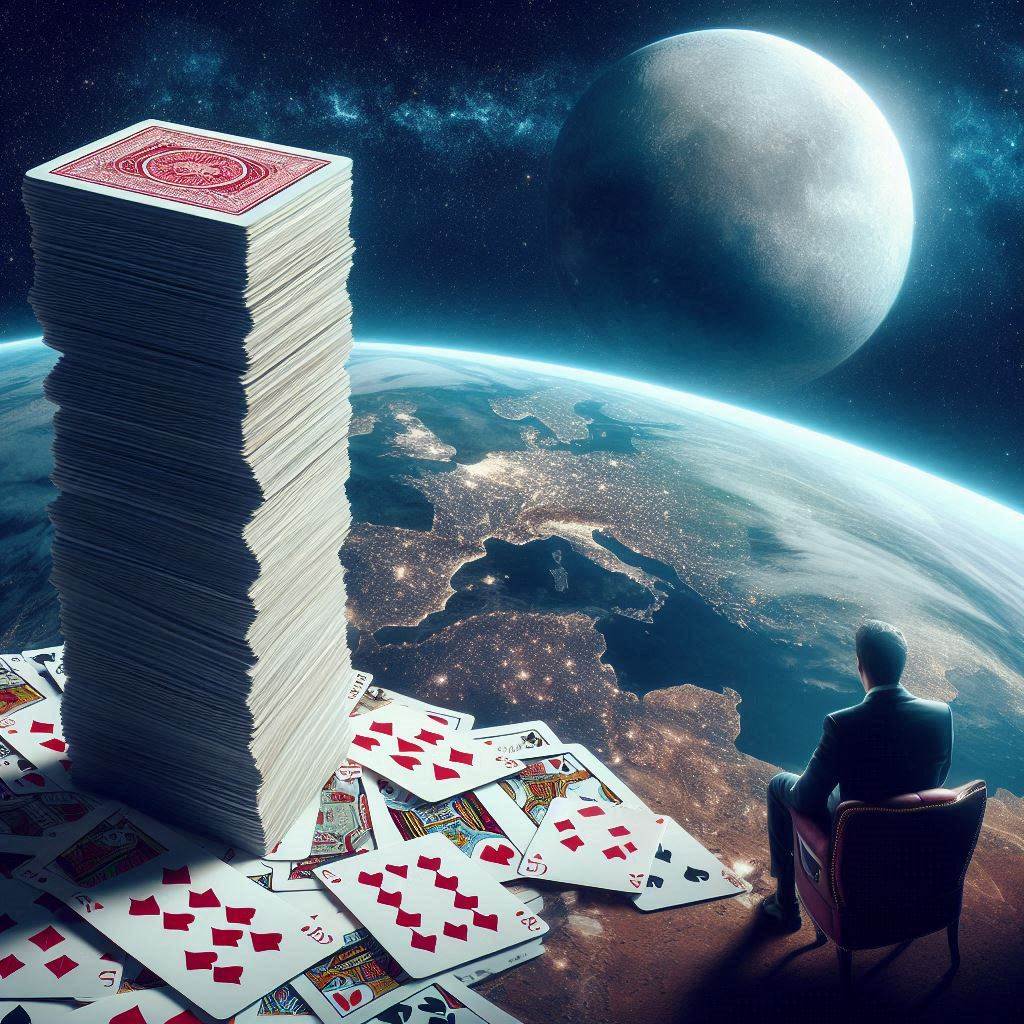
Is the universe actually big enough to simultaneously store all the possible combinations of playing cards?
May seem random, but I’m curious, because this type of question is important for understanding whether abiogenesis (living things emerged from non-living) is a viable theory.
A normal deck of cards has 52 cards, plus 2 jokers, plus a title card. That’s 55 in total.
In Australia, we play a game called “Five-hundred,” which has 66 cards in the deck.
Turns out, the magic number is 62.
If a card deck had 62 cards, instead of the regular 52 cards, the universe would NOT be big enough to simultaneously store all the different combinations.
You can fit about 7475 decks of 62 cards into a cubic metre. For the volume of the universe, I am using 3.58×10^80 cubic metres as a “close enough” estimate. (I just googled it.)
There are 62! (62x61x60x59x59…) different combinations of card order for this 62 card deck.
A moment or two of arithmetic later, and it turns out the universe would only fit about a twelfth of the possible combinations.
Drop the deck to 61 cards, and you have a lot more room. Only 18% of the space in the universe would be taken up by cards.
Oh, and a standard 52 card deck? Let’s say we created a sphere around the Milky Way Galaxy. Would this be enough space to store all the combinations? Not by a long shot! Only if you removed all the Aces of Spades would it fit inside the sphere, taking up about a third of the volume.
This is relevant to the question of abiogenesis (the creation of life from non-living matter), because of the slim probabilities involved in, say, stringing together amino acids to build a protein. Is the universe even big enough for all those random collisions to take place?
 This is Jotham - Author