

Now we come to the finale, wrapped up in the most difficult passage in Hosea, in Chapter 13:
So I will be like a lion to them,
like a leopard I will lurk by the path.
I will attack them like a bear bereaved of her cubs,
and will tear open their rib cage.
There I will devour them like a lion,
as the wild beast would tear them to pieces.
We’ve already seen how from Gomer’s point of view, Hosea’s consistency and soothing kindness feels like teeth and claws. In these lines, God uses the same motif, speaking to Hosea about the way Hosea will deal with Gomer, and the way that God will deal with Israel. Read those words again. Don’t they sound horrible? If this is God’s way of dealing with humans, then he really is a dishonest merchant who loves to oppress. If this is Hosea’s way of healing his wife, then, quite bluntly, he is an asshole. “You’re not doing what I say, so I’m going to punish you and destroy you!”
So I dug deeper. Has this passage been translated properly?
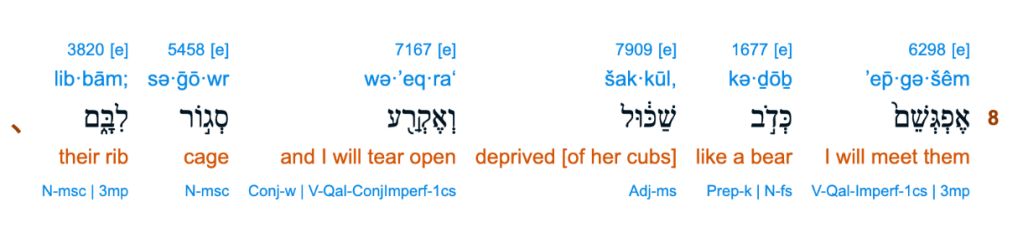
To understand the interlinear tranlation in the image, you need to remember that Hebrew reads from right to left.
The first thing I noticed is the use of simile and metaphor. It’s like a bear.
God is describing to Hosea that he is planning to do something strange. From the perspective of his people, it will seem like he is a lion, or a lurking leopard, or like a bear without cubs. Now, I’ve never met a bear without cubs, but I’ve seen enough TV to know that they are violent, unreasonable and relentless.
What is the strange thing that God will do? What is the strange thing that Hosea will do, under God’s direction, to his wife?
I will tear open…
What will God tear open?
Can you see that word right on the end? It says “libbam”. This comes from the word we’ve seen before: labab. It doesn’t mean “rib,” it means “heart.”
Is is the heart that gets torn open? I don’t think so. Look at the word before it. “segowr.” This word has travelled over oceans and centuries and retained its meaning in English. Change the S to a C, rearrange the vowels, and the word is still there. “Cage.”
The translators did not study Hosea carefully. They did their best, of course, but they had a whole book to translate. I submit that a much better translation of the sentence is this:
I will tear open the cage of your heart and devour it.
It is not the heart that is devoured, but the cage!
Oh, what good news!
The heart is precious. The heart is made to be free, not caged up, not bound in lies. God promises a moment where he will free his people, where he will devour the lies that control them.
Love does not destroy. Love liberates.
Of course, from the perspective of Gomer, from the perspective of Hosea the Israeli, from the perspective of any human being who finds himself or herself in the paws of a wild God, the moment of freeing the heart feels terrifying! But then it is done.
And God calls out,
O Israel, you are destroyed,
but in Me is your help.
The Last Chapter
Hosea doesn’t tell us about the moments when the world turned right way up again, but we can see from the words he penned at the end of his memoir that it did indeed work out for them, and that they lived happily ever after.
I have changed the pronous to reflect, not God’s thoughts about Israel, but Hosea’s thoughts about Gomer. (I hope you can extend me the grace to mess with the text)
I will love [her] freely,
For My anger has turned away from [her].
I will be like the dew to [Gomer];
[She] shall grow like the lily,
And lengthen [her] roots like Lebanon.
[Her] branches shall spread;
[Her] beauty shall be like an olive tree,
And [her] fragrance like Lebanon.
And the relationship between Gomer and her own children was restored also…
Those who dwell under [her] shadow shall return;
They shall be revived like grain,
And grow like a vine.
Their scent shall be like the wine of Lebanon.
And finally, we hear Gomer speak…
[Gomer] shall say, ‘What have I to do anymore with idols?
I have heard and observed him.
I am like a green cypress tree;
Your fruit is found in me.
I have heard and seen him? Hosea! He has gotten through! The translators have not been consistent here. The underlying Hebrew word for “heard” is the same as back in Chapter Two, when Hosea said to himself, “she will respond.” Now, after all that time, Gomer has seen him for who he has become, not the dishonest merchant, but the man who truly loves. Her husband.
Your fruit? Is Gomer pregnant to Hosea? It certainly sounds like that… And Hosea puts his arm around Gomer and holds her close. She tips her head onto his shoulder and puts her hand on her swelling belly.
The camera pans out and lifts, and the sun sets across the vineyards, and their children run and play through the rows heavy with sweet fruit.
Who is wise?
Let him understand these things.
Who is prudent?
Let him know them.
For the ways of the Lord are right;
The righteous walk in them,
But transgressors stumble in them.
 This is Jotham - Author
2 responses to “The Cage. The Finale (Hosea Part 8)”
[…] Next… (Part 8) […]
LikeLike
[…] The Cage, The Finale – Hearts were made to be free, cages need to be destroyed. […]
LikeLike