
I intended to go in a different direction with this train of thought, but I came up with something useful and interesting, I think.
I don’t write novels for entertainment. I write them as stories of deep, deep transformation. I’ve been a little worried that the story of Em (Manessa) will not have the depth of Holding On, that it’s just an ‘and then… and then…’ story.
But I think this one goes deeper. It’s about shame and the crushing burden of guilt, so I’m doing some pretty heavy research for the novel, including research into attachment styles and trauma survival. But if that’s all this book is about, then it’s a dead end. It must be about something different: lifting the burden of guilt and restoration of relationship. This is the story that people need to hear – The good ending, not the bad middle.
At church this week, I have been asked to take the class for teens. The study is meant to be on Jesus’ prayer in John 17 that has as one of its focii, “all of them may be one.” The lesson notes attempt to make this concept interesting, but I can see that its creators have really struggled to connect the dots in a way that will make deep meaning for the teens. The lesson has not considered the forces at play between human hearts, that resist and compel human togetherness.
Not that I have a firm grip on this subject!
But Jesus did. He understood human nature inside-out. We can see this in the glimpses that the Bible record gives us. How did Jesus gain this deep understanding of human nature? How did he learn it? This is what I think:
One. Introspection.
It’s clear from Jesus’ own words about himself that he knew himself:
“Though I bear witness of Myself, My testimony is true. For I know where I came from and where I am going.” (John 8:14).
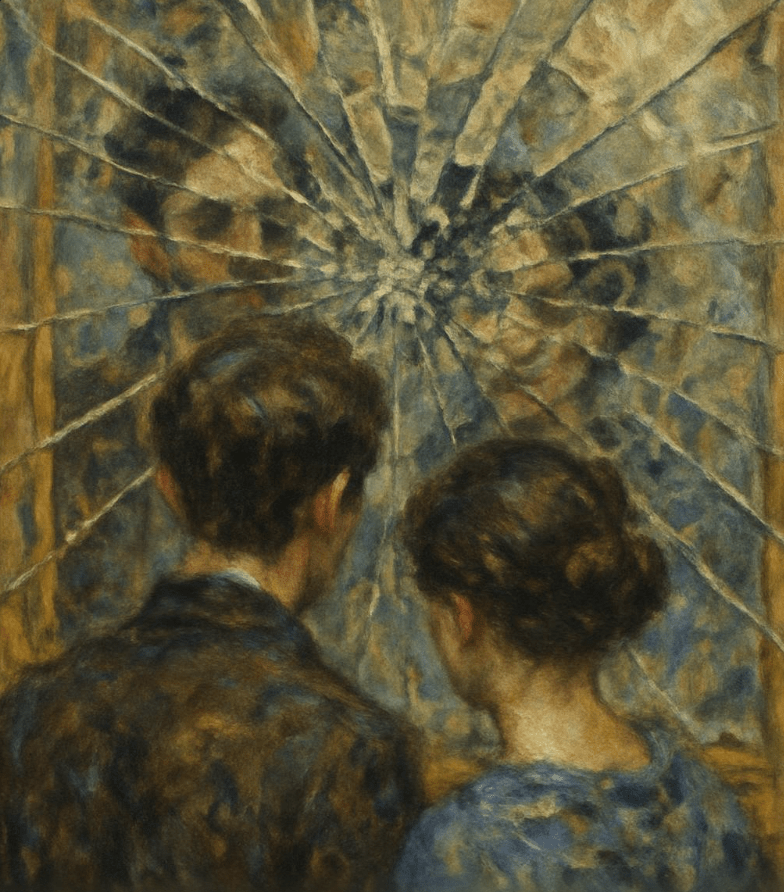
The difference between Jesus’ instrospection and mine is that I have, at my core, the same broken, twisted nature I inherited from my father’s father’s father Adam, and Jesus did not. The mirror inside him that he saw reflections in was clean and smooth. The mirror inside me is shattered into shards.
Two. Observation of others.
It’s also clear from the Bible that Jesus was a keen observer of the people around him. Here’s one such quote:
“But Jesus would not entrust himself to them, for he knew all people. He did not need any testimony about mankind, for he knew what was in each person.” (John 2:25)
Because his heart was not shattered, he could use it to clearly see others; he didn’t confuse his own intentions, hang ups and desires with theirs.
If you’re thinking I’m somehow making a metaphor of the self as a camera, with its mirrors and lenses, you’re right. It’s curious that Jesus mentioned hearts, eyes, lamps, light and darkness:
The eye is the lamp of the body. If your eyes are healthy, your whole body will be full of light. But if your eyes are unhealthy, your whole body will be full of darkness. If then the light within you is darkness, how great is that darkness!
Furthermore, when Jesus read the Scriptures, he understood them. Because his internal lenses and mirrors were clean, and because he had a different nature from everyone else on the planet, he was able to naturally read the story of the human race in Scripture in a way that the rest of us can’t. Indeed, we can figure it out, generally with divine help, I guess, but it’s not obvious.
When I started this train of thought, I was aiming at the topic of the “Prototypical Narrative of Shame”, and I wanted to spend some time looking carefully at the story of Adam and Eve and the Snake and the Tree and the Curses in Genesis 3. believe this is one such story that Jesus could read very carefully, with his crystal-clear heart, and it a story I need to study closely to understand shame and reinstatement for my novel.
I feel like this train ride has nearly come to an end, so I’ll be quick:
Then the eyes of both of them were opened, and they realized they were naked; so they sewed fig leaves together and made coverings for themselves.
8 Then the man and his wife heard the sound of the Lord God as he was walking in the garden in the cool of the day, and they hid from the Lord God among the trees of the garden. 9 But the Lord God called to the man, “Where are you?”
10 He answered, “I heard you in the garden, and I was afraid because I was naked; so I hid.”
11 And he said, “Who told you that you were naked? Have you eaten from the tree that I commanded you not to eat from?”
12 The man said, “The woman you put here with me—she gave me some fruit from the tree, and I ate it.”
13 Then the Lord God said to the woman, “What is this you have done?”
The woman said, “The serpent deceived me, and I ate.”
Some quick observations.
“Then the eyes of both of them were opened, and they realised they were naked” – This is the exact moment that the internal mirror became shattered.
- Eve felt the eyes of her husband on her naked form, and felt uncomfortable, invaded, judged, objectified, owned.
- Adam felt the eyes of his wife on his naked form and felt exposed. His whole body was tuned to respond to her. Wasn’t he just being cheap and manipulative?
- Eve looked at Adam and felt disgust and insecurity.
- Adam looked at Eve and felt betrayed, out of control, afraid.
It’s curious that Adam says it is Eve who told him he was naked. In our culture, we talk about the “male gaze,” but I suspect the female gaze, “Ugh! You’re naked!” has done just as much, if not more, damage to the human family.
I’m guessing here, and looking at the situation through my own broken lense, but I’m onto something, aren’t I? Can you see it? What have I missed or distorted?
Notice, that God asks four questions: Where? Who? What? and a closed question, requring a Yes or No response. In answer to “Where?” Adam gives an explanation as to why he was justified to play “games”, and to run away: “Can’t you see you came at a bad time, God? I was in the natch, and I just got out of the shower, and I was scared, so I hid.” There are so many things going on here: Adam’s subtle claim to the need or the right to privacy, Adam’s fear (of what?), Adam’s desire to justify himself.
To “Who?” Adam could simply have said, “Her,” but instead, he passive-aggressively blames God: “The woman you put with me.” And instead of answering “Did you eat from the tree?” with a Yes, he again tells a story and pushes the responsibility onto Eve.
The “What?” question is directed to Eve: “What have you done?” Gramatically, the most honest way to answer this question is to begin with “I” and then add a verb. Eve, however, begins with the words, “The serpent–” She too tells a story, shifting blame and responsibility.
I notice that nothing Adam or Eve said was a lie. It was all the facts.
I suspect that when Jesus read this passage, he found Adam and Eve’s reactions very strange and unnatural. They think they are being crafty and clever, but their explanations and blaming are about as obvious as an infant trying to disappear behind a blanket, or a child with their faces covered in food trying to tell Mummy that they haven’t touched the donut.
 This is Jotham - Author