

This has all the chapters, in order, that have been posted to the blog so far.
-
Holding On – A Story of Loss, Courage and Friendship
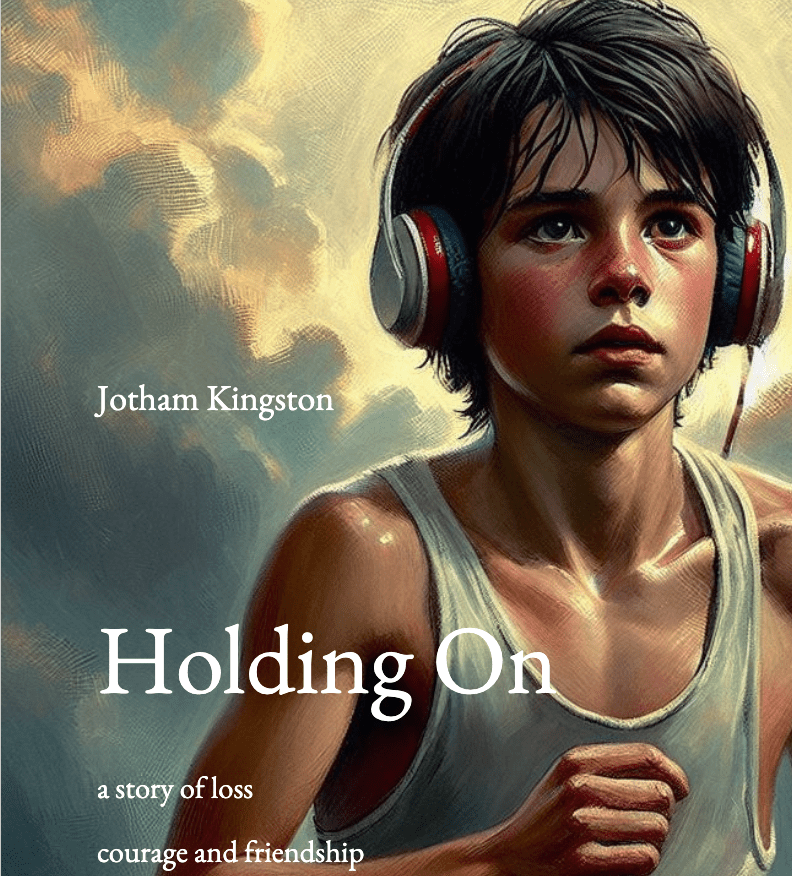
About six months ago, I deced to write Ant’s story. It’s been rolling around in my head for a long time. At one stage I wrote a screenplay for a short film based on the same plot. I got some great feedback, but I didn’t continue with it, because life happened, and writing is really, really hard.
If you happen to have been on my website for the last few months, I had a large chunk of my first draft up for viewing. Now that I’ve finished the writing, and the manuscript is ready to go out to agents and publishers, I’ve taken most of it down.
You can still read the first few chapters here and a synopsys here.
-
Holding On – First Four Chapters
Prologue
Cassette Tapes
This story happened when haircuts were a different shape and walls were a different colour and computers made funny noises when they connected to the internet. People listened to music with CD players and, to be honest, they were pretty cool. A CD was a plastic disc a little smaller than your outstretched hand. The good thing about CDs was that the sound was very clear. The bad thing was that they scratched easily, and you couldn’t really exercise with a CD player, because jumping around made the laser lose its focus on the tiny pits in the CD’s surface.
If you wanted to exercise with music, you could go retro, and use cassette tapes. But hardly anyone did this, because cassette tapes were very uncool.
A cassette tape was a rattly plastic box about the size of a modern smartphone. It held a reel of thin plastic ribbon that had a funny, sickly smell. When you put the cassette tape into a cassette tape player, the ribbon rolled off one reel, past a gadget that ‘read’ the magnetic pattern encoded into its metallic dust, and rolled onto a second reel. The magnetic pattern made the music, and when the reel was empty, you turned the cassette tape over in the cassette tape player, and it played music from the other side of the ribbon, all the way back to the beginning.
Cassette tapes were uncool because the sound quality wasn’t as good and because they used old technology, but the younger generation at the time had no idea of the absolute magic they missed out on.
The absolute magic of cassette tapes that their parents knew was that you could collect your own music. You didn’t have to buy songs from the record shop, you could record your own, off the radio.
It was like catching fish. They’d hang by the radio all evening, fingers hovering over the buttons at the beginning of every new song, just in case it was the one they wanted. If it was, they’d punch down two buttons at the same time, Play and Record, to get the song as early as possible. If their song didn’t come on and they got frustrated, and then they took too long in the toilet, they might return to discover their song had already begun, and they would have to wait, at least until the next day, when the song got played again.
You can understand the fierce ownership people took of their music. It was ‘their song’, because it took so much effort to capture.
Now, a ‘mixtape’ was something special. If a girl liked a boy, she might sit by the radio night after night, recording romantic songs that reminded her of him. If she was very brave, and they were ‘going out’, she would give the mixtape to him, and everybody at school would find out. If she was not so brave, she might just listen to the mixtape herself while she stared up at the moon outside her bedroom window, thinking about him, wondering about the future, wondering what might happen.
But, as I said, when this story took place, cassettes were already a thing of the past, of an earlier generation. Tapes that had escaped the rubbish pickup were stored in cardboard boxes in the corners of garages, where the years faded photos and wasps had left nests of hardened mud.
Some say it was a simpler time, a more pure time, but I don’t know. People were still people, so some were kind and some were mean. Love was still love and loneliness was still loneliness.
But I am getting way, way ahead of my story.
1
The Broken Triangle
He had a longer name but most people called him Ant. He was in the last year at Mountain View Primary School, middle-sized, not too short and not too tall, and he had nuggety muscles. Sometimes, when he had his showers in the night time before bed, he stood in front of the mirror wrapped in a towel, flexed his arms and looked at his growing biceps. He was pretty proud of them, but if he ever heard his dad walking up the hall outside the bathroom door while he was flexing, he quickly dropped his arms and turned away from the mirror, just in case his dad knocked on the door and came in.
His dad never did, of course. His dad, whose name was Martin, sometimes stood outside the door and saw steam curling up from underneath and knew that Ant had, once again, forgotten to turn on the exhaust fan. But he never went in, because Ant was becoming a young man and needed his privacy. Already, in Martin’s thinking, Ant had crossed that invisible line from child to boy, which meant that sometimes he messed up Ant’s hair or gave Ant a side-hug, but he didn’t give him a cuddle like when Ant was a toddler. Ant called Martin ‘Dad’, and Martin called Ant ‘Champ’ or ‘Chief’ or ‘Mate’ or ‘Sport’ or whatever came handiest at the time.
The third person in the triangle was Rosie. Rosie Barnett. Beloved Wife and Mother. But that corner of the triangle had been rubbed out about a year ago, leaving the triangle open, with broken sticks for legs, reaching out into the void.
It was cancer. It was quick. It was over before they could prepare for it. It was like one day Rosie was there, lighting up the room, making sandwiches at the kitchen counter, singing loudly to the radio. And then she wasn’t.
But Rosie was still the reason for so many things they did. She was the reason Martin slept on his side of the queen bed and didn’t cross the half way line. She was the reason the radio in the kitchen had been pulled out of the wall socket and was now covered in paint splatters in the back of Martin’s van. She was the reason they ordered pizza every Thursday night and ate it straight from the box on the lounge room floor. She was the reason Ant made the sandwiches now, every morning. For himself he made a sweet one, with peanut butter and honey, or peanut butter and jam and he made a salad one, with a slice of cheese and some lettuce and tomato and cucumber and sprouts or whatever else was in the fridge. He made his dad two salad sandwiches, because that’s what Rosie had always made him.
On school mornings Martin dropped Ant out the front of his school and then he drove in his white tradie van to wherever he was painting for the day. He set up his ladders and drop-sheets, sometimes the lights, but always Rosie’s radio. And he listened to talkback and ads, and sometimes classical music. But he never, never, moved the dial to Rosie’s station. She had loved anything she could sing and dance to, so she loved the disco songs from the Seventies and Eighties most of all.
At lunch-time, Martin sat on an empty paint tin, unwrapped the sandwiches and munched on them, staring somewhere past the wall while the spotted radio blared on about politics or computer science or problems with the roads. Then he scrunched up the plastic wrap, put it in an empty paint tin and kept painting.
2
Many Cheese Chinese
At school, Ant was in the second row, near the wall of windows. He sat beside a girl with orange hair pulled into a ponytail with a green scrunchy. She also had orange eyelashes, a pointy left elbow, special felt pens, one eraser that looked and smelled like chocolate, and another that she said smelled like blueberries. She didn’t like talking to Ant, and a couple of times when he asked to borrow her eraser, she sighed and said, under her breath so he could hear, “Why don’t you buy your own?” So Ant didn’t ask any more.
Ant’s books were messy. His pencils were never sharp because his sharpener was broken. (It turns out that chewing down the tip of a pencil like a beaver is actually possible, but it makes a mess.) When he made a mistake, and he made lots, he had an old rubber band that he used as an eraser, and it smudged his thick, waxy pencil everywhere. When he tried to write, he couldn’t make nice shaped writing like Miss Dougall did on the whiteboard. His letters were thick and square and nuggety like his body, and his words weren’t spaced evenly.
If his writing was bad, his reading was worse. Take, for example, when Ant was asked to read to the class the words Miss Dougall had written on the whiteboard. She looked at him with her pretty, neat, mascara smile, and tapped at the sentence with a wooden ruler. At his desk, Ant squinted and twisted his head. The sentence didn’t seem to make sense to him, and even though the words were written firmly on the whiteboard, it seemed to Ant like they were sliding all over the place, fleeing away from him like kittens that didn’t want to be caught. He took a breath and started reading.
“Many cheese Chinese came—”
A ripple of laughter broke over the class. Miss Dougall’s eyes flicked over the students and she seemed to slump a bit, like someone had let some air out of her, but she looked at Ant again patiently. “Many Chinese came—”
Ant felt a sharp elbow in his right rib. He glanced over at Manessa, who was making a face at him. He rolled his eyes and gave her foot a little kick under the desk and looked at the board again. Sure enough, the words had rearranged themselves, and now said, Many Chinese came, without the cheese.
Ant reddened.
“Have another go,” Miss Dougall said.
Ant took another deep breath.
“Many Chinese came to Australia druring the and godshruuuuu—” His voice went up at the end like a question mark. He had no idea what the word was. It looked like a whole lot of letters had been thrown together, like the bucket of garden tools in the corner of the garage at home.
The class laughed again. But this time there was a snort from the other side of the room. At Mountain View Primary School in Year Seven that year, it was called ‘dropping a piglet’, and it was code for “You are an idiot!” It had started at the beginning of Term Two, when someone had accidentally snorted while laughing at a video in class, and the guys, who thought that all educational videos were dumb, found much humour in copying the accidental snort. Soon it had worked its way in, everywhere. Everybody was doing it. And by ‘Everybody,’ I mean, of course, Holden James and his gang of skater friends. The best bit about dropping a piglet was the plausible deniability. “It wasn’t me, Miss. I was just laughing, Miss.” Yet dropping a piglet at just the right time could be like a dirty bomb to the intended victim’s self esteem. And that’s exactly what it had done now. Ant looked from the whiteboard to Miss Dougall and back again, like a lost sailor looking between the ocean and the punctures in the life raft. He had no idea what word he was up to. Miss Dougall could see he was sinking, but knew the worst thing she could do from the front of the room in this moment was to rescue him, to offer help.
Ant felt a kick at his ankle and heard a voice beside him hiss, “‘Goldrushes’, dummy.”
“Shut up,” he shot back under his breath.
Holden James made the mistake of dropping another piglet, and Miss Dougall’s eyes, which were on Ant and saying, I’m so sorry for embarrassing you, flicked to the other side of the room, hard and narrow.
The sniggering stopped.
“That’s right,” Miss Dougall said, talking loudly and quickly, pacing among the desks, “Many Chinese did come to Australia during the gold rushes. They were adventurous and brave, and they came to the Victorian goldfields in the hope of becoming rich.”
She passed in front of Ant and touched his desk lightly with her fingers. An unspoken apology. Ant gratefully slumped back in his chair. A few years ago, before Mum died, they had gone on a holiday to the south coast of New South Wales. The waves had been big, the hangover of an earlier storm. Ant had ventured out into the ocean with Mum for a morning swim. The sun had burned his eyes and the water had roared in his ears and he had got dumped. A big wave reared up and grabbed him, lifted him high, and then slammed him down, bucking and kicking and rolling him over and over in the sandy whitewash. He still remembered the sting of salt in his nose, and the desperate need for air, and the feeling of being alone, trapped under the water with no-one to help him. And all he could do was wait. Wait until the wave passed over and let him go. That’s what it felt like now, with the burn of embarrassment on his face and the sharp pain in his ribs where Manessa had dug into him. He just had to wait for the moment to pass.
3
The Walkman
When the lunch bell rang, Ant got his sandwiches from his bag and went out to his quiet place. From here he could look out at the suburban street beyond and see an occasional car. This was the place he waited to get picked up by his dad. It wasn’t the normal kiss-and-ride spot, but back then, primary schools weren’t all trussed up with high fences like they are now. Ant munched on his peanut butter and honey sandwich, and when he was finished, he scrunched up the plastic wrap, pushed it into his pocket and waited for the second bell, so he could get out on the field with the Year Six boys and kick the soccer ball around. It was the best part of his day, but when his dad picked him up in the afternoons, Ant never told him anything about it.
“How was school, Champ?” Dad asked, flipping his wrap around sunglasses up onto his head.
Ant pushed the large work diary to the middle to make room on the seat and threw his bag into the foot well. “Good. How was work?”
“Good.” Dad checked his mirrors and pulled out.
“Can I run again today?” Ant asked.
“Of course,” Dad said. “I need to go do a few more hours tonight, okay?”
“Yeah, that’s fine,” Ant said.
Dad flicked on his blinker and made a turn, and then pulled over. Ant had already taken off his school shirt to reveal his running singlet. He had kicked off his school shoes and put on his runners.
“There’s some leftover potato salad from last night in the fridge, or you can do one of those lasagnas in the oven. Up to you.”
Ant nodded. “Thanks, Dad.”
He reached into his bag and pulled out a black box, a little bigger than his hand with a pair of headphones plugged into it. The box had a row of buttons down one side and a sticker on the front that said, among other things, ‘MEGABASS’.
Dad saw it and gave a small laugh. “Is that your mum’s old Walkman?” He held out his hand and Ant passed the box over. Dad pressed a button and the door on the front of the box flew open. He pulled out the cassette tape and examined it more closely. It had a sticker with the words BASF and DOLBY NR and 90 MIN written on it. Ant had no idea what any of those words meant, because they certainly didn’t sound like English. What was important to him were the words in his mother’s handwriting. Dad read them out. “‘Rosie’s Groovie Grooves’, hey?”
“Yep,” Ant said. “It helps me run.”
Dad smiled. “I bet it does, Chief.” He fitted the tape back in its place, clicked the door down tight and then passed it back.
Ant took it, fitted the headphones to his ears and tucked the Walkman down his shirt so the cord wouldn’t flap around.
“See you at home, Boss,” Dad said.
“See you at home, Dad,” Ant replied.
Dad pulled away with a small beep of the horn, and Ant was left to himself.
They did this quite often. School policy said that kids couldn’t walk home unaccompanied, so Dad picked him up from school and dropped him around the corner, and then he went back painting for a few hours and Ant ran. Sometimes Ant went straight home. Sometimes he took detours. Running was his thing. He loved the loneliness and the rhythm of his feet. He loved thinking about just the count of his breaths against his steps. He loved running on the flat. He loved hills. He loved the music that was his mum’s and the memories it brought.
Ant stretched out his calf muscles on the kerb, took a deep breath and pressed Play.
At first there was nothing, and then a familiar hiss, and then the song started. The drums and bass line in the introduction reminded him of a growing ladder, and the guitar line sounded like it was a fast-growing vine shooting up through the rungs, reaching this way and that way as it grew, but always twisting. “Did you know,” Mum used to yell over the intro, while she started bopping about the kitchen “That the Gibb brothers grew up just north of Brisbane, on Cribb Island where the airport is now?”
“Yes, Mum, you tell me every time!”
She would shake her head and laugh. “It wasn’t a real island!”
“Every time, Mum!”
Then the singing started.
“Well, you can tell by the way that I use my walk–”
But Ant wasn’t walking.
He was running.
Leaning forward into the song, letting his feet go free.
He ran down the footpath, with the road on his right and the small factories on his left, two steps to every crack in the concrete, in time with the music.
4
The Gallant Hero
The classroom door slid open about a half hour before recess. The Principal, Mrs Wilson stuck her head in and called Miss Dougall over quietly. It was Maths, and the class was working through a page in the Maths book. Ant was pretty good at Maths, even if he couldn’t read the questions properly, but the numbers made complete sense. Manessa, the orange-haired troll beside him, was breathing heavily through her mouth and rubbing out yet another answer. She had a tiny pink calculator to check her results, which was very much against the rules, but that wasn’t any of Ant’s business. Ant was finished, and he was sitting quietly, which is why he had noticed the door slide open.
Mrs Wilson, the Principal, had her body in the door opening and was talking quietly with Miss Dougall, their heads close together, in that special adult way that teachers use when they don’t think students are watching. Ant saw Miss Dougall nod in agreement and then turn to cast her eyes about the room. She saw Ant looking at them, said a few more words to Mrs Wilson and then beckoned him over with a finger.
Ant got up and walked over. Mrs Wilson opened the sliding door, and Ant followed her out into the hallway, curious.
Standing beside Mrs Wilson was a girl. She was a bit taller than Ant and she had long, dark, straight hair that hung down her back. She wore a neat uniform. Ant noticed that her socks were very white and fluffy, and they were pulled up to exactly the same height. She stood with her two feet close together. Some strands of her long hair were wrapped with cotton, in orange and blue. Her mid brown eyes had a slight upward tilt at the outer edges, like the genii on the old TV show that played in the afternoons sometimes, and her skin was smooth and even.
Ant glanced at Mrs Wilson, and then to Miss Dougall, who was now standing in the sliding door with her back to the classroom, simultaneously supervising the class and blocking their view.
“This is Molly Wang,” Mrs Wilson said to Ant. “She will be joining your class, because she has just moved to the area with her family.”
Ant looked at Miss Dougall. She nodded agreement.
Then Mrs Wilson addressed the new girl. “This is Anthony Barnett. He is here because he has finished his Maths, and he is going to help by getting you a desk from the store room next to the library and setting it up.”
Ant glanced at Molly Wang and felt his heart leap in surprise, because she was staring squarely back at him, He could see the patterns of her irises. He quickly looked away. Mrs Wilson was holding out a bunch of keys. “Thanks for your help, Ant,” she said. “Here is the key to the store room. I have a meeting with Molly’s mother, and I know you are capable of sorting out the desk. You will need a chair as well.”
Ant took the bunch of keys. “Okay,” he said. “I can do that.”
He left the three of them in the hall, feeling self-conscious and shy and important all at once.
Mountain View Primary was just a small school, and the store room beside the library was just the other side of the covered area where they stood for assembly. He fumbled with the key, and mercifully it opened without any trouble. Inside was an old photocopier, an overhead projector and a tumble of plastic desks, some right way up, and some stacked upside-down. There were some chairs as well.
“Desk or chair first?” Ant asked himself. If he were a new student with everybody watching, would he prefer to stand behind a desk in a classroom, or to sit on a chair, without a desk in front of him? On the other hand, it might look pretty funny if he came back just holding a chair. Like he was weak or something.
He liberated a desk from the pile, fought it out through the door and brought it back to the classroom. Mrs Wilson was gone, like she said, back to her meeting. The hallway was empty. Ant used the leg of the desk to slide open the door and walked the desk into the classroom.
Molly was standing in the far corner, at the back of the room, with her hands clasped in front. She didn’t look nervous or shy. She was just standing there.
“Please put the desk next to Steph’s,” Miss Dougall said, glancing up from her work. Dutifully, Ant lifted the desk a little higher and got it to the back of the classroom, near where Molly stood. He placed it down and squared it up where it belonged.
Ant risked a glance at Molly. She was looking around the classroom, and she moved a hand to flick some hair away from her face. A half smile was on her lips.
Still, if it was me—, Ant thought.
He retrieved his own plastic chair and put it down behind Molly’s desk. It felt so weird to be the kid in the classroom who was up, arranging furniture while everyone else did school work. Kind of nice.
“There you go,” Ant said, not sure what to do with his hands. Did he point at the chair, or sweep back with a bow and gesture gallantly at the plastic saddle? He decided on something simple, grabbing the chair and pulling it back, so Molly could sit down.
She looked at him and smiled. “Thanks,” she said, and sat, smoothing out her skirt.
Ant fled the classroom, went back to where the desks were kept, grabbed another chair just like his own from a stack and locked the door. He detoured past the principal’s office. The door was ajar, so he knocked quietly and slipped in with the keys. Mrs Wilson was talking with a woman. She broke off to thank Ant, and he left the keys on her desk. The woman glanced at Ant as well. She looked very much like Molly, but her skin was more golden and her eyelids were smoother. She wore a dark business suit and heels. In comparison, Mrs Wilson looked frazzled. Her curly hair seemed to stick out like frayed steel wool and her face looked tired. “Many Chinese came to Australia during the Goldrushes,” Ant said to himself.
…aaand if you want more, you’re going to have to wait for the good folks at Elephant Page Publishing to finish their good work. This book is slated to be published in the second half of 2025.
-
Holding On – Query Letter
Turns out that a query letter is very hard to write.
I spent some time at https://queryshark.blogspot.com/and came up with this:
Dear XXX
I’m seeking representation for Holding On, a 56,000 middle readers reality miniplot drama.
What Ant Barnett needs most of all is for the door to his dad’s heart flung open so he can see the burning furnace inside.
He doesn’t know this, of course. How could he? Ant is a twelve year old kid who is barely holding on. His dyslexia makes the world unreadable, the bullies at school are circling, his mum is dead and his dad is buried under a weight of grief and financial worry.
Running has become Ant’s escape. He laces his shoes and heads out alone, listening to his mum’s old Walkman, vowing to keep her memory alive.
When the neat and self-assured Molly turns up at school, Ant is thrown into a tail-spin. She gets in his space and she talks too much. “What are you listening to?” “What are you eating?” “What does your dad do?”
When she starts moving in on precious memories of his mum, Ant knows he’s got to stop thinking about her, but Holden James, the skateboarding alpha-male of the school, makes that next to impossible.
His mum’s Walkman slides down a stormwater drain like a hockey puck. His teacher is putting pressure on him to invite his father to the school athletics carnival. The end of childhood is looming.
Something’s gotta give. Surely!
If not, he’ll be running alone on the lonely roads, forever.
Comps for this book are Nisha’s War by Dan Smith for writing style and themes, and Black Cockatoo by Carl Merrison and Hakea Hustler, for its Australian themes and suitability as a school text.
I live in regional New South Wales, Australia on a rural property incised by a seasonal creek. I’m an outside-of-the-box secondary teacher and I enjoy talking with young people. I’ve got five kids of my own.
Thanks very much for considering my project.
-
Manessa’s Story – First glimpses of a sequel
Holding On has an intriguing supporting character called Manessa. When I first started writing, I didn’t really care about her. She was just the ‘mouth breathing troll’ with red hair and very sharp pencils who sat next to Ant, but the further I got into the story, the more I realised Manessa was an important part of it. Ant comes to see her, not as a stereotype, but as a fully-fledged, three dimensional person.
I can feel the story of Manessa growing inside of me. I put together an outline of a story, but it was premature. Too much plot wangling and not enough character development. There’s already so much about Manessa that I know from writing her into the first book. I need to sit and wait, and let the story boil away for a while without forcing it.
Manessa’s story will take place when she is about 18 years old, has finished high school and escapes home to go to university, to make a life for herself. One problem is that home follows her and threatens to pull her back into its gravity like a black hole.
What do I already know about Manessa
- She has red hair and was pudgy in primary school. Her posture is not good. She curls her shoulders forward instead of throwing them back. When she throws them back, she is large and alive.
- She is very neat and organised, has sharpeners and rulers and markers. It’s her parents’ idea of care. “You have everything you need for school, now go do school.”
- Her parents own a fish and chip shop. They make reasonably good food, but the place is pretty grotty. Her parents have stressful times when the health inspector comes.
- They live above the shop. Everything in her family is about the shop. We can’t go on holidays because of the shop. We can’t do X or Y because of the shop.
- Her mum yells at her a lot: “Manessa, I don’t believe it!” and has destroyed her self-esteem. She has her mum’s voice in her head, scolding and shaming her very often.
- She checks her maths with a calculator because she has been yelled at so many times for getting it wrong. She doesn’t trust her own abilities, doesn’t put her weight down on her own decision making and often double-guesses herself. This is what causes her maths mistakes.
- Manessa’s parents said they paid her for her work, but they kept most of it for themselves. Their justification is that she doesn’t need the money, and they do, for food and bills. She can’t do university because they have wangled their taxes and she can’t get goverment student assistance.
- Manessa’s physical needs are met by her family, but not her emotional ones.
- She will discover that she is actually a very good singer, and loves soul music – e.g. Joss Stone’s bigger songs.
-
Holding On News – Meeting the Elephant Page Publishing team
I was so pleased (and nervous!) to meet the team at Elephant Page Publishing via video link today. I felt honoured and special to be “believed in” by a bunch of people that I don’t even know. (I was so nervous that I forgot to get a screenshot of the meeting.)

Per, Soraya, Daniel, Kel, Taya, Marcuz (did I miss a name? I think so!) and the rest of the 25 strong crew who I saw but didn’t get to talk with–the ones who are doing the heavy lifting–thanks for all that you are doing to make the story of Ant, Holden, Molly and the rest of the cast sparkle! It was a big day for me today, and talking with you was the absolute highlight.
Some other names I considered for the novel were Staying Alive, Rosie, Holden, Molly, Ant (or variation), Ant’s Burden, The Loneliest Mile, but I’m excited to see what the Elephant Page team come up with — and the artwork as well.
I really enjoy writing characters, even the supporting ones and yes, I do ‘borrow’ from people I already know, but only less than ten percent, so I’m not infringing copyright. I don’t think it’s possible to avoid this. Sometimes I’ll borrow from a snatch of my memories, and I hope that the people I borrow from won’t ever figure it out. Marcel, the laconic French chef in the sequel to Holding On is based slightly on an English chef in my local area. I didn’t realise this fact until I saw him moonlighting in a coffee truck yesterday morning.
My marketing ideas for this book include, but are not limited to: 1. CBCA award, 2. inclusion on Premiers’ Lists, 3. Supplementary material that’s in line with school curriculum requirements for class sets. 4. Whatever else the M&D team tell me to do.
For me, a publishing success would be at least breaking even in the print cost, and getting the book out into schools, I guess. I know how hard the publishing industry is – especially for emerging authors.
It is great working with other sets of eyes in a legit publishing company. There are so many things that you miss when you self-publish. A fresh perspective makes the story much better, I’m learning.
The narration twist (no spoilers) came to me when I started to ask myself the question who the “I” was in the introduction. It wasn’t me, the author. It was someone else. But who? The strange thing is that Ant feels invisible, but there are a few people who saw everything and actually cared.
I don’t know why this story hits such a deep chord with me. I love the last chapters in particular. They are like healing medicine or something. I can’t read them out loud.
Note to self: Be intentional about reading Tristan Bancks books.
-
I ran into ‘Old Paisley’!!!
I ran into my Grade Four teacher a couple of days ago at a conference. Turns out he has moved from Melbourne to NSW. “Thanks for making yourself known to me,” he said at the end.
When I was ten, it seemed this guy was ancient. He was larger than life and we were a little afraid of him, to be honest. I introduce myself and slip in beside him. He seems small and fragile. I tell him I based a book character on my memories of him and he hides his face in shyness. His his movements are quick and sharp, like a bird fluttering at a cage. We catch up a little. I ask if I can take a photo. He agrees, reluctanty. I sneak a look at his hands, wondering if thye are still large and knuckly, and I’m pleased to see that the strength is still there.

Old Paisley was on duty, and he gave Ant a nod from under his wide-brimmed sun hat when he patrolled that particular part of the field where Ant could be seen. Old Paisley always clasped his hands behind his back and had the chin-strap of his hat very tight. It made Ant feel like gagging just to look at it.
The fight was about to go to the next level when a warning trill split the air. Both Holden and Ant looked up. Old Paisley was rushing toward them with his old-man run. He was blowing so hard on his sports whistle that the ball inside it threatened to break the sound barrier.
Holden and Ant were caught in freeze-frame, and Old Paisley’s face was dark with anger.
 This is Jotham - Author