
For me, this realisation was a cornerstone for understanding thinking.
Beliefs
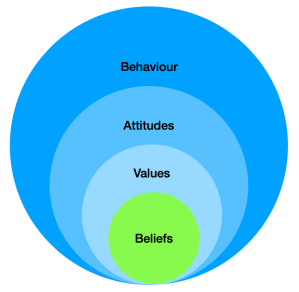
When this diagram was flashed up in my first year university course, I was fascinated, If I understand a person’s underlying beliefs, I can predict their behaviour, I thought.
But what is a “belief”? What form do they take? Nobody explained that bit. I had an idea that they were somehow like dreams, all shadowy and shifty, and they hung around at the bottom of the subconscious ocean like underwater ghosts.
Hold that thought.
Logical Propositions
Concurrently, I was fascinated by the topic of “logic,” mainly because I knew so little about it. Do you remember what old Professor Kirk says in The Lion, The Witch and the Wardrobe?
“Logic,” said the Professor half to himself. “Why don’t they teach logic at these schools? There are only three possibilities. Either your sister is telling lies, or she is mad, or she is telling the truth. you know that she does not tell lies and it is obvious that she is not mad. For the moment then and unless any further evidence turns up, we must assume that she is telling the truth.”
Consequently, I found a book online by Lewis Carroll of Alice in Wonderland fame. The book was called The Game of Logic and it explained what a “logical proposition” was.
Logical propositions all had the same form:
All/some/none of A are/aren’t B.
Here are some examples of logical propositions.
- Some men are good men.
- Some men are not good men.
- All inhabitants of Melbourne are liars.
- No window is a bullet proof.
How, this is something I could understand! It was like maths with language. I saw you couldn’t tell, just from looking at one logical proposition, if it was true or false, but it needed to be tested. And I saw how you could build overlapping propositions to come to a conclusion. (more on that later)
Beliefs are Logical Propositions
Imagine my amazement and surprise when I found some site on the quiet backwaters of the internet that said,
Beliefs are of the form “All/some/none of A are/aren’t B.
Boom!
“Beliefs,” which underly behaviour, are not strange, shadow-like dreams. They are cold, hard logical propositions! Here are some examples:
- God is cruel.
- My father loved me unconditionally.
- My poor health is what makes me miserable.
- All surprises are bad.
- The universe is alive.
- All lies do damage.
This means that the way-down-deep beliefs that people hold can be brought up into the light of day and tested, using the rules of propositional logic. Oh, it might not be very comfortable, and I may discover that I hold some beliefs that are actually false, but I can work with them like lego blocks!
It doesn’t even matter if the subject area is technical or specialised. It’s all just language. Beliefs can be examined and tested, and it’s not that difficult to do.
Next in This Series
Critical Thinking Skill #1 – Test Big Words
Some Other Interesting Links
Holding On, the first few chapters of my teen novel that will be published through Elephant Page in the second half of 2025.
The Hosea series – an eight part exploration of the most powerful love story I have ever heard, with some great relationship advice.
 This is Jotham - Author
2 responses to ““Beliefs” are not shadowy ghosts.”
[…] Beliefs are Not Shadowy Ghosts […]
LikeLike
[…] while ago, I started a train of thought about Critical Thinking. Since the last one, I have been occupied with my current novel, Breaking Free, and haven’t been back to it […]
LikeLike